Review – Paper:Mate Write Bros Medium Ballpoint Pen

Pens, they’re important. Not a lot of them are very useful for the inking process, but they can be useful for simply starting an image, or many other art-things. This one is the Paper:mate Write Bros. medium ballpoint pen.

Ballpoint pens are one of the aforementioned types:  not particularly useful for finished works, especially smaller ones, but good for seeing what things look like in ink, and making sketches or notes that you don’t want to be erased. A fun exercise is always to draw with a cheap pen on scratch paper, preventing erasing, forcing one to improve their ability to create an image on the first try.

Ballpoints make a fairly fine line but they have rough edges, as there is some bleeding. A medium point is good for writing and most other uses, but as mentioned before is not good at detail. The ink is good, it does bleed with water, but is fairly sturdy as far as that goes. It is a deep black that does require a little drying time, but usually no more then a couple seconds. It takes to paper well. I’ve had no problems with the amount of ink in the pen either, I believe it lasts longer then most other ballpoint pens I’ve used, but I haven’t taken detailed records either so take that with a grain of salt.

The pen itself is easy to hold, if a bit slippery and shows all the necessary info (although that does rub off after continued use). It obviously has a cap and clips to a notebook or shirt pocket, which is always handy.

Overall if you are looking for a cheap pen that can be used for a myriad of things around your workspace, this in one I would consider. However I would recommend buying a couple of packages of different types of pens to figure out which one works for you. But it is at least a nice house or office pen, which is what it was designed for.
Review – Strathmore 400 series, 100 page, 8.5X5.5 Sketchbook

Strathmore sketchbooks, specifically in this review the 400 series, 100 page, 8.5″X5.5″ sketchbook.

Design-wise, the cover is acceptable. It certainly does its job and displays all the necessary information in a way that is easy to read, and in three different languages. The stock of the cover and the cardboard of the back are thick and nice, capable of standing up to a great deal of punishment (the back more so, obviously). The back is unbendable without breaking it first, creating a solid drawing surface away from a table, if that’s how you like to draw. The book is spiral bound, the metal of said spirals is superb, they are strong and have enough give and bounce that they don’t bend into a different shape easily. The spine also keeps the pages very secure.

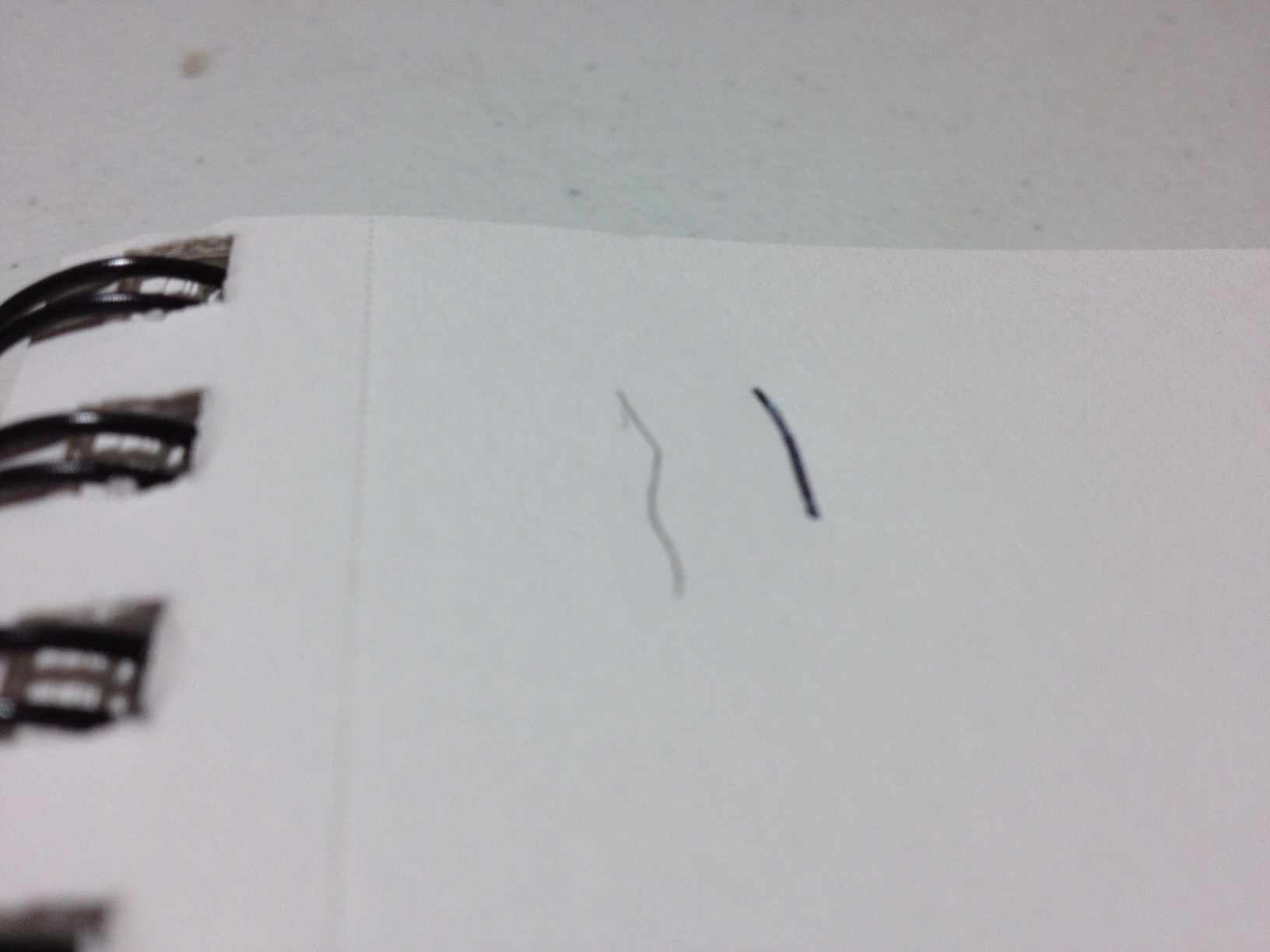
The paper in this book is a medium thickness, thicker than 20-pound, thinner than heavier drawing paper. It is relatively smooth, but still coarse. Good for the main purpose of the book; sketching, but poor for fine detail work as the bumps create imperfections. It is still much less coarse than other sketchbooks by Strathmore. Pencil and ink are taken well by the paper. Pencil smudges fairly easily, and shows through to some degree. Ink is absorbed quickly, making drying time fast and can be seen through the paper. There are 100 sheets in this book, which seems a large number, making the book fat. But that is hardly a complaint. The pages are very nice for their purpose of sketching.

I take a sketchbook everywhere, I try to vary what I take and where, but when all I want to do is a simple sketch, a Strathmore is what I take. They are easy to get, fair priced and a good quality. I would not try to create a “finished” piece on one, but that is not their intended purpose. They help one practice, hone skills, and create technique by being very durable and useable in a variety of conditions. This size of book is great for a bag or carry in the hand (half the size of a sheet of copy paper). It is a great thing to have when one is out and about and would like to sketch anything.

Review – Pigma Micron 05 Technical Pen

Ah, another Micron, this one is the 05 (.45mm) black version. Its main difference from other Microns of course being its nib size.

The pen body is slick but doesn’t slip when pressure is applied. Aesthetically it looks old school with its graphic design, but all the necessary info is readable and in intuitive places. The top of the cap is marked with the size, making finding the correct pen for the job from storage much easier. The overall length and weight of the pen is nice and makes it easy to handle.

Of course the main difference between this Micron and other Microns is the nib size. The 05 nib is a medium size, good for main lines and other things that should be noticed but that you don’t want to emphasize as much (assuming you’re using a broad range of pen sizes). The nib also takes considerably longer to wear out then its smaller counterparts, and one will find the ink becoming grey or stopping almost entirely before wear from normal use is noticeable.

The ink is of course the wonderful Pigma ink, which resist fading and running. It does fade after prolonged times, but not entirely and it is hardly noticeable. It also begins to fade as an eraser is rubbed over it, but this is minor and will only happen once or twice.

Overall the pen is nice and a great value. It is more of a writing size pen then the other pens in the Micron range, making it one of the most versatile of the line.

Review – Norcom Graph Composition Book

There are a lot of sketchbooks and various types of notebooks out there. But a composition book doesn’t seem to scream “art supply”. The binding is great but they’re obviously meant for writing and not drawing. Luckily (kinda) there are math classes in school as well that need notebooks. And this is one of them, the Norcom no. 76002 graph composition book.

The listed dimensions are nine and three quarters by seven and a half inches, with five squares to an inch. Each page has 49 by 36 squares so the given dimensions are mostly correct, but a little off. The book contains one hundred sheets, and some extra stuff on either inside cover.

The paper itself is thin, but not overly so. Pencil and ink can be seen through but not enough to cause trouble in perceiving or creating what is on the page. Ink from pens does not bleed through, but brush inks will, and if a pen is heavily applied over an area bleeding is a very likely occurrence.

The grid is helpful in the way grids are. It is printed light blue, and does not get in the way of writing, drawing, or graphing.

The spine however is poorly made. The string binding is loose and the pages are almost free to move around. While the pages seem sturdy the spine may need duct tape for prolonged use.

Graph paper is very useful and having it in an easily portable book with a “solid” binding is nice. The book is nice for what it is but there are many better (although more expensive) options out there.

Review – Sakura Micron 005 Technical Pen

Ah, Microns, the main technical pen of the trade. This one specifically is the 005 (.2mm) black version. The body is easy to hold. The finish is glossy, but grip-able. It is just long enough to be comfortable in the hand and is a nice comfortable plastic. The nib size is neatly marked on the side and top, making it easy to find the right pen for the job. After much use however, the makings on both the side and top fade away, with the top going first.

The nib is very thin, good for fine detail work and writing. It does bend easily and one should be careful about how much pressure is applied when using it. When the correct amount of pressure is applied the line is very smooth and even. The ink itself is a nice deep black that is resistant to bleeding when wet but does fade when an eraser is rubbed over it. Other then that minor fading the Pigma ink is very reliable. The ink does not bleed through thin paper and mark other sheets below it.

After heavy use the markings on the pen do rub off as mentioned. The nib begins to wear down and the metal past it begins to mark the paper. The lines begin to become jittery and inconsistent. But that is after a long and useful life. The amount of time it takes to wear the pen down to that point is incredible. And it more then makes up for its price.

The Micron is the premiere technical pen (almost) and does its job incredibly well. They are expensive but amazing (in my opinion) and at the very least write well. And the amount of time that they last easily allows for them to be replaced when they begin to show signs of wear.